

 When we stop and take a moment to reflect on all the amazing things the human body does, including our growing understanding of the role neurobiology plays, we begin to recognize its intricate complexities. We grow in our appreciation of the interdependence these magnificently multifaceted systems orchestrate. This holds true for infants, toddlers, tykes, children, early adolescents, adults and elders. Our bodies are amazing self-regulating mechanisms.
Inside your body is an automatic control system that works every second of every day to keep us alive and well. This system is called the autonomic nervous system, and it has two main parts: the sympathetic nervous system (SNS) and the parasympathetic nervous system (PNS). These two systems act like partners and work hand in hand, constantly adjusting your body to meet your needs.
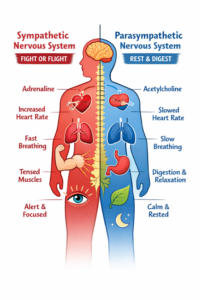 The (SNS) is often described as the “fight-or-flight” system. It activates when you feel stressed, excited, or in danger. In this state, your brain sends signals through nerves and releases chemicals like adrenaline and noradrenaline. These chemicals increase your heart rate, speed up your breathing, send more blood to your muscles, and sharpen your focus. All of this prepares your body to respond quickly to a challenge, whether that challenge is a big test, work/school demands, interpersonal relationships, or even a competitive game.
On the other hand, the (PNS) is known as the “rest-and-digest” system. It is most active when you feel calm and safe. This system releases a chemical messenger called acetylcholine, which slows your heart rate, relaxes your breathing, and supports digestion and energy storage. This system helps your body recover, repair itself, and return to a balanced state after stress.
The main idea is that these two systems are always working together to create balance, a process scientists call homeostasis. These systems constantly adjust like a thermostat regulating room temperature. In the case of our physiology however, what is getting adjusted is our feelings, our moods, our reactions, and our ability to think rationally as well as our heartrate, respiration and body temperature.
This self-regulating balance is controlled by areas deep within the brain such as the hypothalamus and brainstem. The brain monitors, often subconsciously, what is happening inside your body and decides which system needs to be more active.
Understanding that we EACH have our own (SNS) & (PNS) activators, as well our own individual balance points. Cognitive Dynamics can help.


Leave A Comment