

Are you someone who monitors your biological indicators on devices like a smart watch or ring? Even though modern science provides us with these remarkable tools to measure the stress level experienced by individuals. Indicators such as heart rate, blood pressure, oxygen saturation, cortisol levels, skin conductance, and even pupil dilation provide physiological evidence that a person is experiencing significant stress. These biomarkers reveal what Stuart Shanker describes as a shift into “limbic-braking,” where the brain’s emotional and survival systems effectively override the reasoning functions of the prefrontal cortex. Daniel Kahneman American psychologist and author referred to this as System1 thinking (reflexive), taking over for System 2 (reflective) thinking. He found that he could pinpoint when an individual subconsciously felt the cognitive workload was too demanding and shutdown would occur. Remarkably, it occurred when the pupils dilated.
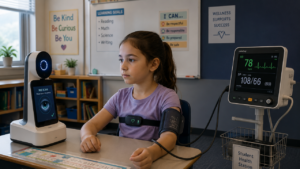 The good news is we now have a much better physiological understanding of what it looks like when effort collapses in a student/child. The bad news is that schools are not equipped with desks that have heart rate, and blood pressure monitors, and/or iris scan devices. BUT! Nor should they be!
Despite the sophistication of these devices, teachers possess something that no wearable sensor can replicate: the ability to recognize meaningful behavioural tells through trusted, prosocial relationships.
A heart rate monitor can tell us that a child’s pulse has increased. It cannot tell us that the unusually quiet student who normally greets everyone with enthusiasm has suddenly withdrawn, stopped making eye contact, or abandoned their typical curiosity. A blood pressure cuff cannot detect the subtle humour that has disappeared, the increased perfectionism, the unexpected irritability, or the child who suddenly asks to visit the washroom five times before lunch.
 These behavioural hints become visible only through relationship and familiarity. Teachers who know their students well develop a mental baseline of what typical looks like for each individual.
This relational knowledge also shapes intervention. Rather than interpreting behaviour as defiance or lack of motivation, educators can ask a more productive question: “What is this behaviour telling me about this child’s stress level?” The answer can then lead to co-regulation, connection, a reassuring presence instead of discipline.
While technology may continue to improve our ability to measure physiological stress responses, the compassionate observations of adults who have invested in authentic relationships remain one of our most sensitive and effective assessment tools.
In the end, the most powerful “sensor” is not attached to a wrist or finger—it is the caring adult who knows the child well enough to notice when something is no longer quite right.






Leave A Comment